
Free CAT4 Level G Year 11 – Year 12 Practice Test & PDF – Maximize Scores & Admission Success
Welcome to your trusted resource for the 2025 CAT4 Level G Test for Year 11 & Year 12!
The CAT4 for these years is the hardest test version, with questions that demand strong reasoning skills.
So, early preparation can help your child feel more confident on test day and increase their chances of scoring high.
On this page, you’ll find all the materials you need to support your child and help them reach their academic goals.
✔️ Start with a Free Practice Test – A great way for your child to get familiar with the test format and pinpoint areas that require more focus.
✔️ Looking for more practice? The complete practice packages include two full-length simulations and 16 practice drills, designed to strengthen problem-solving skills and improve accuracy.
✔️ New for this year: 40+ Short Video Lessons – Available in the practice package, each video explains a selected practice question step-by-step, showing how to solve it and understand the reasoning.
Let’s ensure your child is fully prepared, confident, and ready to achieve their best results!
What’s on This Page

Created by Roman, CAT4 Test Prep Specialist, and His Team of Expert Teachers.
Since 2016, Roman has helped students excel on standardized tests. Together with experienced math, English, and cognitive ability educators, he created these CAT4 practice resources to give your child the best chance at success.
Our mission is to make CAT4 preparation clear, stress-free, and effective.
- Aligned with the latest CAT4 exam format.
- Comprehensive, covering every topic your child needs.
- Built with detailed, step-by-step explanations.
Have questions? Email roman@prepopedia.com – we’re here to help your child succeed!
Take a Free CAT4 Level G Practice Test With Answers [PDF Included]
The following sample questions are also available in two other formats:
- Timed practice test version that simulates the exam’s time pressure.
- PDF sample test for offline practice.
Part 1
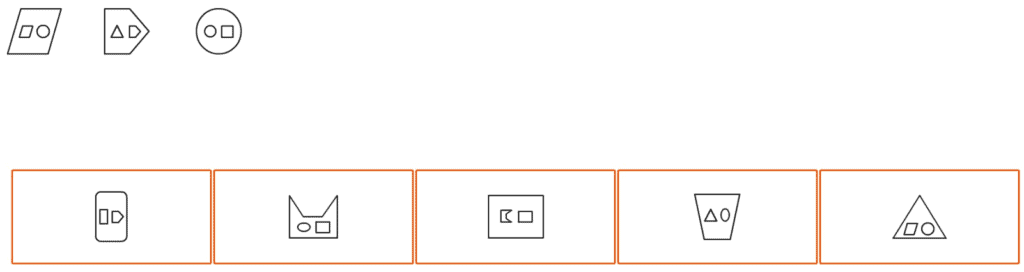
Question #1 – Figure Classification
The Figure Classification questions show three pictures that share a connection or a characteristic. Choose the answer that shares the same connection/characteristic from the answer choices.

Question #2 – Figure Matrices
Figure Matrix questions are either 2×2 or 3×3 matrices comprised of different pictures. In each row and/or column the pictures change the same way or follow the same rule. Choose an answer that goes in the empty box in the matrix following the same rule.

Practice with Questions That Look and Feel Like the Actual Test

How These Practice Questions Are Made
Each question is created step by step to give your child the best possible preparation for the CAT4:
1. Based on Official Examples – The process begins with collecting official CAT4 sample questions and demos, so practice feels just like the real test.
2. Matched to Every Question Type – Each type is carefully matched to the format, structure, and difficulty your child will face.
3. Written to Mirror the Actual Test – New items work the same way as the real test and come with clear, child-friendly explanations to guide learning.
4. Reviewed by a Second Expert – Another teacher or test specialist checks every question to ensure it is accurate and easy to understand.
5. Improved with Feedback – Feedback from parents and students is used to make the practice even more effective over time.
This way, your child walks into the test feeling prepared, confident, and ready to do their best.
Part 2
Question #3 – Verbal Classification
Each question provides three words that are alike in some way. Decide how they are alike, and choose the word that belongs in the same group as the first three words.
bulb | core | seeds
Question #4 – Verbal Analogies
The first pair of words go together in a certain way. Choose the word that goes together with the third word similarly.
locomotor → action : stationary →
Question #5 – Number Analogies
Each question provides two pairs of numbers with a certain mathematical connection and another number that shares that connection with one of the answer choices. Find the missing number for the third pair.
[50 → 19] [40 → 17] [30 → ?]
Many students find Number Analogy questions tricky since the connections between the pair of numbers are not straightforward and take time to figure out.
The best way to tackle this challenge is through practice. The more your child practices, the quicker they’ll recognize patterns and solve these questions accurately.
The complete practice package offers over 70 such questions, giving your child plenty of opportunities to sharpen their skills and improve.
Part 3
Question #6 – Number Series
Each question provides a series of numbers with a rule. Use the rule to determine which number will come next in the series.
2 10 5 6 30 15 16 ?
Spatial Reasoning Sample Questions
Question #7 – Figure Analysis
Each question shows a paper folded several times and then punched with holes. The answer choices contain unfolded papers with punched-in holes. You need to determine which of the answer choices is the final product of the unfolded punched-in paper.

The correct answer is (A).

A paper is cut into a circle, folded into its quarter and its one side is again folded inwards. When a whole is punched into it, it will cut
Question #8 – Figure Recognition
Choose the answer choice that contains the given shape. The shape must keep its size and orientation.

Want your child to be fully prepared?
See the comprehensive practice that matches the real CAT4 and builds confidence for test day.
Keep Practicing and Improving Your Child’s Abilities With the Complete Practice Package
- Full-length CAT4 simulations that mirror the actual test
- In-depth practice drills for each section
- Detailed explanations for all questions
- Step-by-step video lessons
What to Expect on the CAT4 Year 11 & Year 12 Test?
The CAT4 Level G is designed for students aged 14-17 years old, typically in Years 11 and 12. This is the most challenging level of the CAT4, featuring more complex questions compared to the lower levels, and evaluates students’ cognitive abilities in greater depth.
The GL CAT4 comprises four main sections:
Non-Verbal Reasoning: This part evaluates a child’s ability to understand and analyze visual information, which is important for subjects such as science and art.
Verbal Reasoning: This section assesses a child’s ability to understand and reason using words. It is crucial for reading comprehension, vocabulary development, and communication skills.
Quantitative Reasoning: This measures numerical and mathematical ability, helping to predict a student’s potential performance in subjects like mathematics.
Spatial Ability: This section tests a student’s ability to visualize and manipulate shapes and spaces, aiding in subjects like geometry and physical education.
CAT4 Level G Test Structure and Timing
The CAT4 test has three parts, each divided into two or three sections.
Here is a table outlining the specific time limits and the number of questions for each part and section of the CAT4 exam:
| No. of Questions | Time Allotted (in Minutes) | |
|---|---|---|
| Part 1 | ||
| Figure Classification | 24 | 10 |
| Figure Matrices | 24 | 10 |
| Part 2 | ||
| Verbal Classification | 24 | 8 |
| Verbal Analogies | 24 | 8 |
| Number Analogies | 18 | 10 |
| Part 3 | ||
| Number Series | 18 | 8 |
| Figure Analysis | 18 | 9 |
| Figure Recognition | 18 | 9 |
| Total | 168 | Up to 120 minutes (including breaks & settling time) |
The complete CAT4 Level G practice includes two full-length simulations & extra drills covering these three parts (590+ questions in total).
Why Prepare for the CAT4 Level G?
Preparation for the CAT4 test is essential for your child’s academic progress, equipping them with the knowledge and confidence to achieve top scores:
Strengthen Your Child’s School Application Profile
Achieving high scores on the CAT4 highlights your child’s intellectual strengths, making them attractive candidates for elite public, private, and international schools.
Adequate preparation ensures they stand out in these competitive application processes.
Promote a Culture of High Achievement
Educators seek to identify and nurture exceptional students.
High CAT4 scores can result in personalized challenges and attention, fostering a passion for learning, increasing self-confidence, and developing critical skills that are beneficial for long-term success.
Build a Strong Foundation for Future Success
Strong performance on the CAT4 contributes to a compelling academic record, crucial for gaining admission to competitive universities.
Demonstrating commitment and achievement early on sets the stage for your child’s future educational and career goals.
Reduce Test Anxiety and Increase Confidence
It’s common for students to feel nervous about the CAT4. Consistent practice and familiarization with the test format are the best ways to alleviate this anxiety.
As your child becomes more accustomed to the exam, their stress levels will decrease, and their confidence will increase, leading to better performance on test day.